Appearance

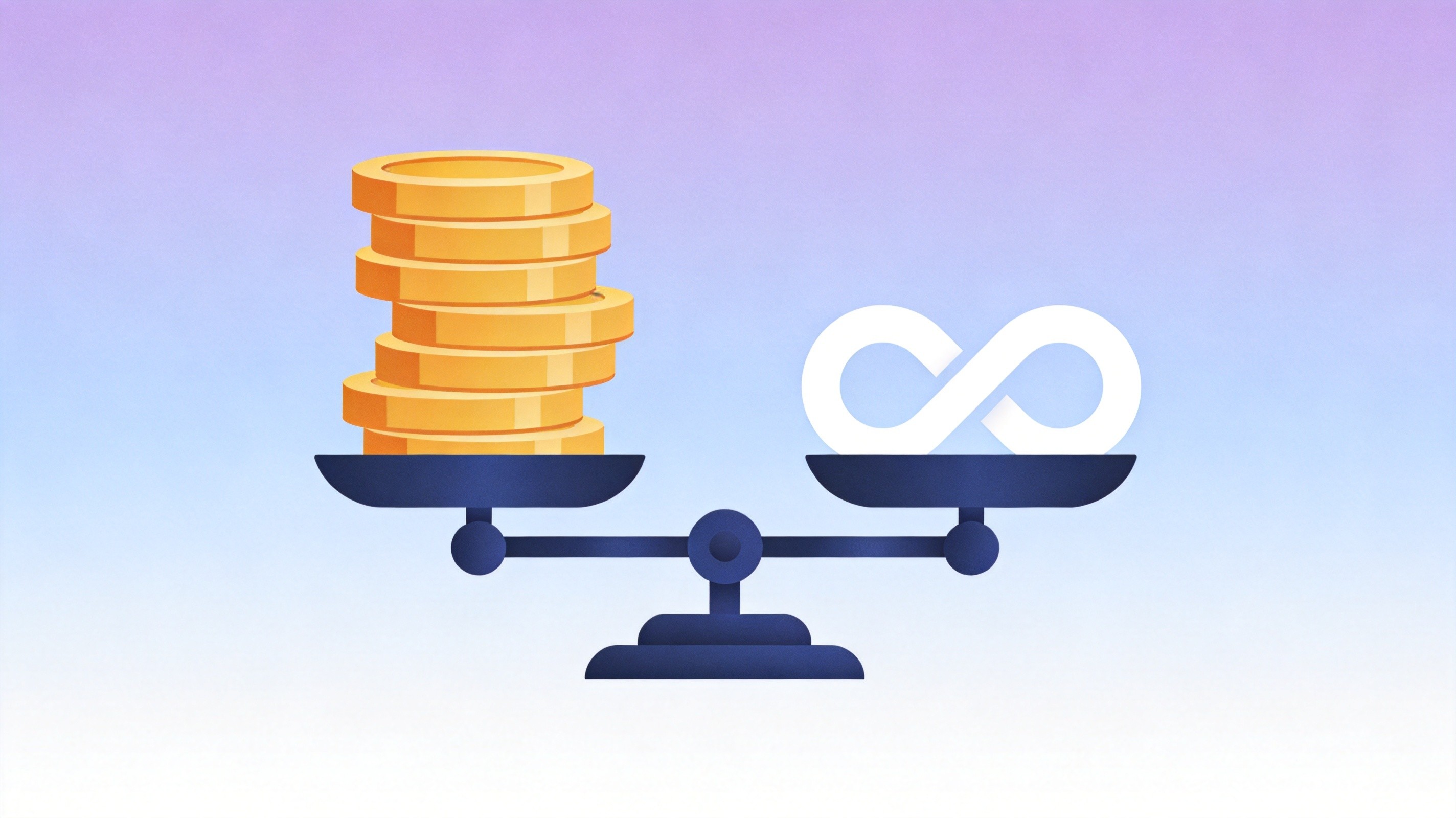
AI Point Systems vs Unlimited Subscriptions: Which Actually Saves Money in 2026?
Nobody advertises the number that actually matters. That number is your cost per finished piece of work — one report, one image set, one video clip — and it depends on which billing model you're standing in. A $20 "unlimited" plan and a $15 points plan can both be excellent deals. They can also both be bad deals, for the same person, two months apart.
The comparison feels impossible because the two models fail in opposite directions. Subscriptions hide your cost and cap your throughput. Points expose your cost and cap your budget. Neither is cheaper in the abstract.
This breakdown prices three user profiles against both models, finds the crossover point, and gives you five checks to see which side of that line you're on. Nolvia's published tiers are the benchmark — $15 for 45K points, $30 for 100K, $60 for 200K.
Table of Contents
- How the Two Billing Models Actually Work
- The Sticker Price Problem With Three $20 Subscriptions
- Three User Profiles, Two Bills
- What Your Dollar Actually Buys
- The Hidden Advantage: You Stop Paying for Models You Never Touch
- The Hidden Risks Nobody Prices In
- Where Subscriptions Still Win
- How to Tell Which User You Are
- FAQs
- Related Articles
How the Two Billing Models Actually Work
A subscription sells access to one vendor's models for a flat fee, with a usage cap that marketing calls "unlimited." Those caps are real and usually expressed in time windows rather than monthly totals. Claude Pro resets on a five-hour rolling window. ChatGPT Plus caps messages on its flagship model and routes you to a slower one when you hit the ceiling. You don't get a bill for going over — you get a worse product for the rest of the day.
A point system sells capacity instead of access. You prepay for a monthly pool — 45K, 100K, or 200K points — and every interaction draws from it at a rate set by the model and the size of the request. Cheap fast models sip. Flagship reasoning models, image generation, and video generation drink. One pool covers all of it.
The structural difference matters more than the pricing difference. Subscription budgets are fixed while throughput varies; with points, you choose the model, which means you choose the burn rate. The failure modes diverge too — running out on a subscription downgrades you to a slower model, while running out of points stops you cold.
The Sticker Price Problem With Three $20 Subscriptions
Three tools at $20 each is $60 a month, and that's the easy part. The hard part is that those $60 buy three separate caps that can't talk to each other.
You can't move unused capacity from the tool you barely touched to the one you hammered. Burn through your ChatGPT Plus allowance by Tuesday, use Claude twice all week, and there's no mechanism to rebalance. You pay for both and absorb the throttling on the tool carrying your work. Our comparison of individual subscriptions versus a single aggregator walks through that inefficiency.
There's an inflation ladder baked into the "unlimited" label. The $20 tier is the entry point of a range that runs to $100 and $200 a month on both major vendors. Heavy users don't stay at $20; they get pushed up by the same caps marketed as unlimited.
That's the real cost of the subscription model: not the $20 sticker, but the $200 ceiling you get shoved toward once your usage grows into it.
Three User Profiles, Two Bills
Here's where the argument becomes arithmetic, at 30 days a month. Point consumption comes from working assumptions — roughly 30 points for a mid-tier text exchange, 250 for a flagship session or long-document pass, 300 for an image, 3,000 for a short video clip. Those rates are illustrative, not a published rate card. What drives the conclusion is the ratio between models, not the absolute figures.
| User profile | Monthly volume | Points needed | Point plan and cost | Subscription stack and cost | Cheaper |
|---|---|---|---|---|---|
| Light | 300 text exchanges, 10 images | ~12,000 | Standard, $15 (27% of 45K) | One tool $20, two tools $40 | Points, by $5–25 |
| Medium | 1,500 text exchanges, 20 long-document passes, 40 images | ~62,000 | Pro, $30 (62% of 100K) | Two tools $40, three tools $60 | Points, by $10–30 |
| Heavy | 6,000 text exchanges, 60 long-document passes, 100 images, 10 short videos | ~255,000 | No published tier fits — 200K is the ceiling | Three tools $60 with hard caps, or one $200 tier | Subscriptions, if the caps hold |
The light row is the one people get wrong. A light user on Standard pays $15 and uses about a quarter of the pool. Their effective rate is $1.25 per 1,000 points against a nominal $0.33 — overpaying roughly four times per unit of capacity. They still spend less than almost any subscription stack, because the absolute number is small. Efficiency and total cost are different questions, and points win one while losing the other.
The heavy row is where points break. At 255K points of demand, the top tier of 200K doesn't cover the month, and there's no upgrade above it. The options are rationing, splitting across accounts, or moving back to subscriptions. For that profile, points aren't expensive — they're insufficient, which is worse.
For what each tier includes beyond the point count, the tier comparison for Standard, Pro, and Ultimate covers it line by line.
What Your Dollar Actually Buys
Normalizing to cost per unit of work makes the comparison legible. Here's what 30,000 points buys at each tier — the same 30,000 points in every row, so you can see how different the underlying work is for identical spend.
| What 30,000 points buys | Cost at $15 / 45K | Cost at $30 / 100K | Cost at $60 / 200K |
|---|---|---|---|
| 1,000 mid-tier text exchanges | $10.00 | $9.00 | $9.00 |
| 100 generated images | $10.00 | $9.00 | $9.00 |
| 10 short video clips | $10.00 | $9.00 | $9.00 |
Pro and Ultimate are priced at an identical $0.30 per 1,000 points while Standard costs $0.33 — the entry tier is slightly worse value per point, small enough to ignore. The ratio between modalities is what matters: one short video clip costs about as much as 100 text exchanges. A user who thinks of themselves as "a text person who occasionally makes a video" is really a video person who occasionally writes.
That ratio is the most useful number here. Your point budget doesn't care how often you use a modality. It cares how much of the expensive one you use.
The Hidden Advantage: You Stop Paying for Models You Never Touch
Subscriptions charge you for a vendor's entire lineup whether you use it or not — you buy Claude Pro for Opus and also pay for everything else Anthropic ships that quarter.
Points flip that. Use a fast lightweight model for 80% of your work and a flagship for the 20% that needs reasoning depth, and you pay flagship rates on 20% of your volume instead of buying a flagship subscription and running it at a fifth of its capacity. The pool is shared across 40+ models, so the budget follows your decisions rather than your vendor's catalog.
The clearest case is occasional access to an expensive modality. Need eight short video clips a month? A video subscription is absurd for that — a full monthly fee for a handful of outputs. Eight clips at 3,000 points each is 24,000 points, comfortably inside the $15 tier. You get the capability without buying the category.
The same logic applies to model churn. Models get replaced every few months, and a subscription ties your money to one vendor's release schedule. A points pool lets you switch the moment a better model ships, at whatever the new rate happens to be. For the broader market picture, our 2026 subscription cost comparison covers how tiers stack up across vendors.
The Hidden Risks Nobody Prices In
The points model has four real weaknesses, and none of them show up in the sticker price.
Unused points expire. Nolvia's points reset on your billing cycle, and unused balance doesn't carry into the next month. That's the mechanism behind the light-user inefficiency above: you prepaid for capacity you didn't consume, and the capacity is gone. Subscriptions waste money the same way, but the waste is easier to see on a points dashboard, which is arguably a feature.
Usage is genuinely hard to predict. Text volume is steady. Image and video volume isn't, because iteration is cheap and creative work is non-linear. One afternoon of prompt tweaking can consume a week's budget. People who get burned by points almost always have spiky usage, not high usage.
Model pricing is uneven enough to hide mistakes. Defaulting to the flagship model for formatting tasks can burn three to five times the points you need without noticing. The gap between a fast model and a flagship on a trivial request is pure waste, and it stays invisible unless you check the rate before you hit generate. Our guide to tracking and optimizing point usage covers the habits that close it.
Running dry is a hard stop. A subscription degrades you; a points pool stops you. If your work is deadline-driven, that difference matters more than the dollar comparison. Budget 20–30% headroom, or accept that the last week of the month is a gamble.
Where Subscriptions Still Win
Points aren't universally cheaper, and the places where they lose are predictable.
You need exactly one model. If your workflow is genuinely single-vendor — one model, one interface, no cross-checking — a $20 subscription beats the $30 tier once your usage passes about 45K points. You'd pay $30 for capacity you could get for $20, plus breadth you don't need. Points only win on price when you'd otherwise pay for two or more subscriptions.
You're past 200K points a month. This is the hard ceiling. Above roughly 200K points of demand, no published tier fits, and a subscription stack — even a $200 one — becomes the only path that doesn't involve rationing. Heavy video producers and teams running continuous generation hit it fast.
You need a vendor-only feature. Deep research modes, native integrations, voice, agentic tooling — some capabilities exist on one platform and nowhere else. If your work depends on one of those, the subscription isn't optional regardless of price.
The crossover, stated plainly: points win when your monthly demand fits under 200K points and you'd otherwise pay for two or more tools. Subscriptions win when you need one tool, or when your demand exceeds the top tier's ceiling. Between those poles, the deciding factor is how many separate bills you're paying.
How to Tell Which User You Are
Five checks, ordered by how much they'll tell you.
Count your paid AI subscriptions. Two or more, and the points model is almost certainly cheaper — that's the case the math favors most heavily. One, and you're in the narrow band where a subscription can still win.
Look at how often you got throttled last quarter. Not how much you used — how many days you hit a cap and kept working at reduced quality. More than a handful means you're paying for capacity you can't access, which is the exact problem points solve.
Classify your demand shape. Steady daily usage suits both models. Spiky, deadline-driven usage suits subscriptions better, because a points pool punishes spikes with a hard stop while a subscription absorbs them with temporary throttling.
Measure your visual share. If images and video are more than about 30% of your monthly output, model the point budget on those alone before comparing prices. Text-based estimates will undershoot badly.
Run one month at the entry tier and read the utilization number. The only test that produces real data. Finish under 40% utilization and you're over-tiered — drop down or accept that you're buying breadth, not capacity. Hit the ceiling in week three and you're under-tiered, which changes the arithmetic entirely.
Try Every Major AI Model in One Workspace
Nolvia gives you GPT, Claude, Gemini, Grok and 40+ models in a single subscription — no API keys, no juggling five tabs.
Start Free on NolviaFAQs
Are AI credits actually worth it compared to a $20 unlimited subscription?
For anyone paying for two or more AI tools, usually yes — the point model typically costs less than half of a multi-subscription stack, and it lets you spend on expensive models only when a task needs them. For a single-tool user with moderate volume, the $20 subscription is often cheaper in absolute dollars. The deciding variable is how many separate bills you pay.Do unused points roll over to the next month?
No. Points reset on your billing cycle, and any balance you don't spend doesn't carry forward. That's why utilization matters as much as the sticker price — a $15 tier used at 27% capacity has an effective cost roughly four times its nominal per-point rate. Finish the month with most of your pool intact and you're on a tier that's too high.What happens when I run out of points mid-month?
Generation stops for paid models until your cycle resets, so size your tier with 20–30% headroom instead of budgeting to the edge. Users who check consumption daily and shift routine work to lighter models usually finish with room to spare, even on the entry tier.Is a points plan cheaper than paying for ChatGPT Plus and Claude Pro separately?
At $40 a month for those two, the $30 tier with 100K points is cheaper and covers both model families plus image and video generation. The gap widens as you add tools: three subscriptions at $60 line up exactly with the top tier, which also removes the three separate caps you'd otherwise juggle.How many points does a typical conversation use?
The workspace displays the per-model rate before you generate, and the spread is wide: a short exchange with a fast model costs a fraction of a flagship reasoning session or long-document pass, and image and video generation sit higher still. Treat any single published number as a planning figure and check the rate on the model you actually use.Related Articles
- Nolvia Pricing Tiers Explained: Standard vs Pro vs Ultimate (2026)
- How to Track and Optimize Your AI Point Usage on Nolvia
- 2026 AI Subscription Cost Comparison: Where the Money Actually Goes
- AI Aggregator vs Individual Subscriptions: The Real Savings
- API Costs vs Aggregator Pricing: What You Actually Pay For