Appearance
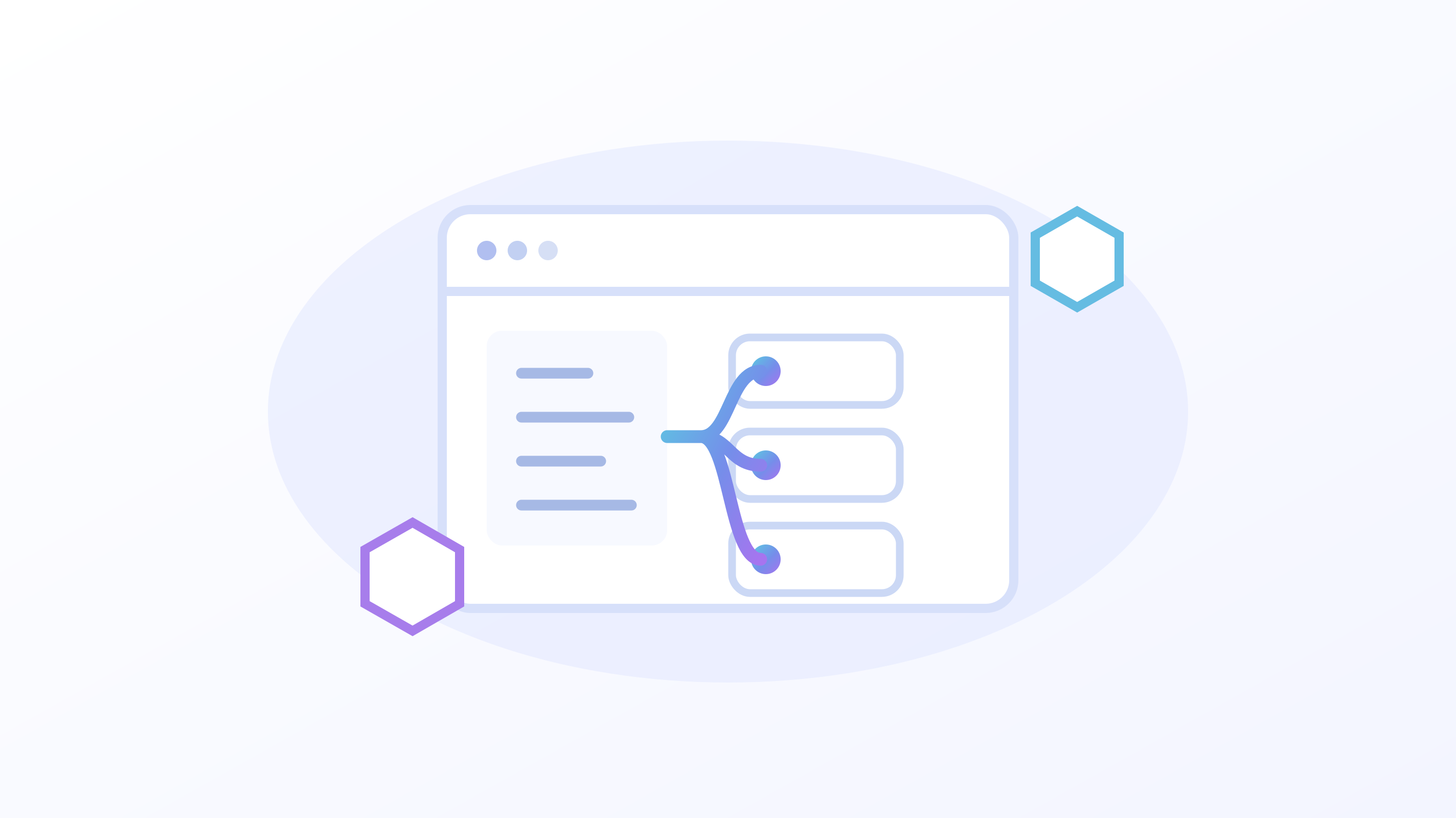
Multi-Model AI for Developers: A Practical Setup for Coding, Review, and Debugging
Quick answer: A multi-model setup works when it routes a narrow task to the model that reliably clears that task's acceptance criteria. It fails when it becomes a collection of chat tabs with no ownership, evaluation set, or fallback rule.
Table of Contents
- What to Route and What Not to Route
- A Developer Routing Table
- Build an Evaluation Set
- Fallback and Escalation Rules
- Security and Repository Controls
- FAQs
What to Route and What Not to Route
Route tasks with a clear success condition: generate a typed interface, explain a failing test, extract an API contract, review a diff, or convert a design note into acceptance criteria.
Do not automatically route decisions with unclear ownership: production migrations, security exceptions, customer-impacting policy changes, or changes with no reproducible test. AI can assist those tasks, but a human should control the decision and the final edit.
A Developer Routing Table
| Task type | What success looks like | Default route | Fallback |
|---|---|---|---|
| Codebase exploration | Correct files and constraints identified | Long-context analysis | Human-guided search |
| Small implementation | Focused diff and passing targeted test | Code-editing workflow | Smaller patch or manual edit |
| Independent review | Specific, relevant findings | Separate reviewer model | Senior engineer review |
| Debugging | Reproduction and smallest fix | Reasoning/debug workflow | Instrumentation and manual triage |
| Structured extraction | Valid schema and traceable fields | JSON-capable model | Deterministic parser |
| UI or diagram input | Correct interpretation of visual evidence | Multimodal model | Written spec plus human review |
The table does not need model names to be useful. Add names only after a measured evaluation shows a repeatable advantage for your repository.
Build an Evaluation Set
Use 10 to 30 redacted tasks from real engineering work. Include:
- a failing test with a known expected fix;
- a bug report with incomplete reproduction notes;
- a small feature with acceptance criteria;
- an authorization or input-validation edge case;
- a structured-output task with a schema validator;
- a code-review diff containing deliberate defects.
Score outputs before you compare them. Useful metrics include task success, test pass rate, false-positive review findings, time to first usable output, cost, and human correction time.
Fallback and Escalation Rules
Write fallback rules before a model fails in a release window:
text
If a model returns invalid JSON twice, switch to the deterministic parser.
If a code change touches authentication, payment, or permissions, require human review.
If a task exceeds the context or latency budget, split the task and re-run the evaluation.
If a provider is unavailable, use the documented fallback only for non-sensitive work.
This turns “try another model” into an operational decision rather than an ad hoc response.
Security and Repository Controls
Use the least context needed. Exclude secrets, production tokens, customer records, proprietary documents, and unredacted logs unless the data flow is explicitly approved. Restrict repository permissions, review every command that changes state, and keep tests as the source of truth.
AI output is a proposed change, not evidence that a change is safe. Tests, code review, threat modeling, and rollback plans remain necessary.
Use a Multi-Model Workspace Deliberately
For teams that need text, code, image, and review workflows, one workspace can make a fixed evaluation set easier to run across multiple models. The benefit is reduced context switching and comparable evidence, not a promise that every model is interchangeable.
Try Nolvia after you have defined a task set, evaluation rubric, and approved data boundary.
Need to test coding, review, and debugging tasks without switching between separate chat tabs? Try Nolvia to work with multiple AI models in one place and compare outputs against the same task brief.
 Try Nolvia — All AI Models in One Place
Access 40+ AI models for text, image, and video generation — one subscription, one interface. Starting at $15/mo.
FAQs
Why would a developer use more than one AI model?
Different tasks can have different requirements for code editing, long-context analysis, structured output, multimodal input, latency, and cost. A multi-model workflow is useful only when a measured task benefit exceeds the added complexity.
How should developers route tasks between models?
Route by task constraints, not model hype. Define a default model for a narrow task, a fallback for failures, and an escalation path for high-risk work. Review the routing rules with representative tests.
Can AI models safely access a production repository?
Access should follow the same least-privilege and change-control rules as any other tool. Avoid sharing secrets and sensitive customer data, use approved environments, and keep a human accountable for reviews and merges.
What metrics matter in a multi-model coding evaluation?
Measure task success, test pass rate, review findings, latency, cost, format reliability, and the human time needed to correct outputs. Keep task definitions and provider settings stable across comparisons.